


Managing environmental, social, and governance (ESG) issues has become essential for the success and long-term stability of companies around the world. However, adopting ESG principles is not only a moral obligation but also an opportunity for growth, innovation, and strengthening stakeholder trust within the value chain.
At Apsolon, we believe that ESG is not just an obligation but a path to sustainable business and excellence. Our expert team consists of experienced advisors who are ready to support your company in developing and implementing a comprehensive ESG strategy tailored to your goals and values.
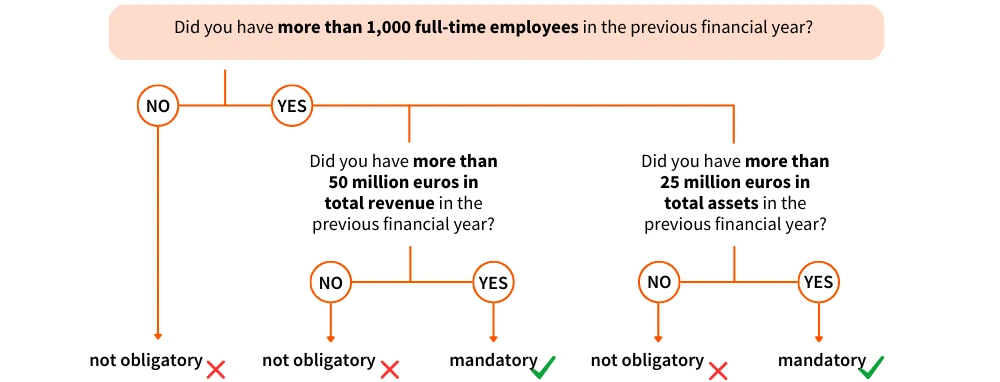
Check if you are required to report under the ESRS standards/CSRD directive:
ESG service packages for Entities not subject to reporting
PACKAGE 1:
BASIC
ESG OVERVIEW
The Basic ESG Review is intended for “outward” communication.
It enables companies to present their practices to customers, partners, and financial institutions through concise and professionally prepared ESG materials, respond to ESG inquiries, and lay the foundation for further development of ESG activities.
PACKAGE 2:
ESG STRATEGIC FRAMEWORK AND REPORTING
The ESG Strategy and Reporting Package is designed for companies that want to methodically develop their ESG system, identify compliance with standards, and establish key policies, indicators, and ESG reporting.
The service includes a customized methodology, recommendations for improving ESG management, carbon footprint calculation, defining ESG policies, and preparing ESG reports according to voluntary (VSME) standards.
PACKAGE 3:
ESG OPERATIONAL MANAGEMENT
AND SUPPORT
The ESG Operational Management and Support service provides continuous professional support throughout the year to companies that want to reliably manage ESG topics without employing ESG experts in their own organization.
It includes all elements of the basic and ESG strategic framework and reporting packages, such as ESG diagnostics, carbon footprint calculation, ESG policy development, ESG reporting according to VSME standards, transition plan and KPI system.
PACKAGE 1: Basic ESG Overview
A concise overview of activities for business communication, ready to use
Companies are increasingly receiving inquiries about their ESG practices from customers, business partners, and financial institutions. In order to be able to respond to such inquiries quickly and without significant engagement of internal resources, it is important to have prepared and clearly structured information about relevant activities. The basic ESG overview intended for communication “outwardly” allows companies to clearly and structuredly present their practices and prepare content to respond to various ESG inquiries, while setting the basis for further development of ESG activities.
- Defining key ESG messages and creating content for web and promotional materials
Preparing ready-made texts on ESG activities, including defining key ESG messages that enable a clear presentation of the company’s ESG activities, for use on the web, social networks, and other communication channels. - Company profile from an ESG perspective
A structured overview of ESG activities and practices, ready to use in offers, presentations, and communications to various external stakeholders. - Basic overview of CO₂ emissions for the needs of ESG communication
Creating an indicative review of CO₂ emissions (Scope 1 and Scope 2). It includes a summary overview of the shows and the preparation of content about the shows and related activities for use on the web, in promotional materials, and in responses to ESG inquiries.
Through this basic ESG review, the company gets a clear and credible picture of its sustainable business practices and has prepared information and materials for a quick and professional presentation to customers, partners, and financial institutions, thus positioning itself as a competitive and responsible business partner.
PACKAGE 2: ESG Strategic Framework and Reporting
The ESG Strategic and Reporting Service Package is intended for companies that want to methodically develop their ESG system, identify the current level of compliance with standards, and establish key policies, indicators, and reporting according to relevant standards. The service provides a “tailor-made” methodology for industries such as construction, manufacturing, tourism, and trade, and enables organizations to clearly identify ESG risks, opportunities, and priorities.
Through an analysis of existing practices and compliance with market expectations, companies receive concrete recommendations for improving ESG management, a quantified carbon footprint, defined ESG policies, and a structured ESG report according to voluntary (VSME) standards. The result of the process is a clear basis for strategic sustainability management, including a transition plan and a system of key ESG indicators that allow monitoring progress and preparing for future regulatory and market requirements.
The service package can be combined with modules (elaborated by sector).
PACKAGE 3: ESG Operational Management and Support
Expert ESG support throughout the year – without the need for recruitment
The ESG service package that provides continuous professional support and assistance with operational management is intended for companies that need reliable ESG support and operational management of the ESG segment without employing ESG experts in their own organization.
The package includes all elements from the basic and ESG strategic and reporting service packages, including ESG diagnostics, carbon footprint calculation, ESG policy development, ESG report according to VSME standards, transition plan, and KPI system.
In addition, you receive constant professional support and operational coordination of ESG activities, which ensures consistent management of ESG topics, timely preparation of responses to ESG inquiries, and continuous improvement of the ESG system.
ESG contact person
We provide clients with the availability of an expert contact person who acts as a central point for all sustainability-related issues. We provide continuous support to management and key departments in understanding ESG requirements and making relevant decisions.
ESG Activity Coordination
We coordinate the implementation of ESG initiatives within your organization and monitor the activities defined by the transition plan to ensure their timely and effective implementation.
ESG Inquiry Management
We provide support in preparing responses to ESG inquiries from banks, investors, and partners, including reviewing and refining ESG questionnaires and supporting ESG due diligence processes and tenders.
ESG KPI Monitoring
We support the collection and structuring of ESG data and monitor key ESG indicators so that the organization has a clear insight into the progress and achievement of set goals.
ESG Documentation Management
We ensure the updating of ESG policies and refining of ESG reports and communication materials so that the documentation is aligned with market expectations and the development of the organization.
Expert ESG Support
We provide ongoing consulting on ESG market requirements and good practices, and support in identifying and developing new ESG initiatives.
Through this continuous support, ESG activities are carried out systematically, the information you have is accurate and timely, and you can respond to the requests of customers, partners, and regulators in a timely and reliable manner.
ESG service for reporting entities
Evaluation of the current situation from an ESG perspective
Analysis of environmental, social, and management factors on external and internal business factors in order to identify criteria for monitoring within the ESG report. Next to the analysis, there follows the identification of potential and actual effects and risks on the business and the value chain of the organization according to the principles of materiality and double materiality, and then the implementation of a GAP analysis to identify future steps in the implementation of ESG and benchmarking in relation to other stakeholders in the value chain.
Sustainable business through the development of an ESG Strategy
We offer long-term support during the development and implementation of sustainable business and the achievement of environmental, social, and management goals through the creation and continuous development of an ESG strategy according to the company’s business strategy and long-term goals.
Creation of ESG Reports in accordance with ESRS standards
We prepare an ESG report according to ESRS (European Sustainability Reporting Standards) standards, with criteria that are determined to be significant according to the principles of materiality and double materiality, with the described methodology and relevant information. At the client’s request, we provide assistance in establishing a data collection system within the company for easier data management when creating reports.
Systematic monitoring, auditing, and re-evaluation of ESG goals for your business
We provide continuous support in monitoring the progress of achieving the set ESG goals with a clear vision of the company’s sustainable business, re-assessing the current state as needed to optimize the transition process towards sustainable business. At the client’s request, we educate your team on the importance of ESG in business and the application of sustainability principles within the company.
What you can expect from us

Expertise
Our team combines an understanding of ESG principles with extensive experience in various industries to provide you with the highest quality advice and solutions.

Customized approach
We understand that every company has unique challenges and needs, so we develop customized ESG strategies that reflect your business goals and values.

Collaboration
We work in partnership with you to ensure that your ESG strategy is in line with best practices and relevant regulations.

Continuous support
Our support does not stop after the creation of the strategy. We stay with you to help you implement, monitor results, and adjust your strategy as needed.
Our successful projects
Our client from the processing industry sector, with whom we have gained experience and shared successes through many different projects for many years, approached us with an ambitious goal – he needed a clearly structured, professional, transparent and comprehensive Sustainability Report that would simultaneously take into account not only the peculiarities of the business and market of each member of the group, but also the standardized requirements of the parent company.
Read the success story
Testimonials
No posts foundFrequently asked questions
What is ESG?
ESG (Environment, Social, Governance) refers to a set of criteria that assess how a company manages its impact on the environment, its relationships with people and the way it manages its organization. In the European Union, ESG is increasingly regulated through a legislative framework such as the Corporate Sustainability Reporting Directive (CSRD) and the ESRS standard, which makes certain companies obligated to report on sustainability, while others introduce ESG voluntarily for reasons of competitiveness and the demands of business partners.
Why introduce ESG into your business?
ESG is no longer just a reputational issue, but also a business requirement. An increasing number of banks, investors, customers, and regulators are seeking information on business sustainability. Companies that systematically manage ESG issues find it easier to obtain financing and investments, participate in international supply chains, reduce operational and reputational risks, and meet EU regulatory requirements.
What are the benefits of integrating ESG?
Integrating ESG principles into business can bring: better access to financing (banks and funds increasingly require ESG data), competitive advantage in the market and in international supply chains, reduction of business risks through systematic management of environmental and social issues, stronger reputation with customers, employees, and partners, compliance with EU regulations, and preparation for future reporting obligations.
Whom is the service intended for?
The service is intended for companies that want to systematically manage business sustainability, and in particular: companies that are subject to ESG reporting obligations (CSRD), companies that are part of international supply chains, companies that plan investments, financing, or entering a new market, and companies that want to improve their ESG performance and reputation.
Will ESG become mandatory for all companies?
Not necessarily for all companies to the same extent, but the European Union regulatory framework is gradually expanding sustainability reporting obligations. Currently, the primary reporting entities are large companies, financial institutions, and listed companies, which report according to the Corporate Sustainability Reporting Directive (CSRD) and the European Sustainability Reporting Standards (ESRS). However, companies that are not formally reporting are also increasingly required to provide ESG data due to bank and investor requirements, participation in international supply chains, applications for EU projects and public tenders, and requirements of large customers who collect ESG data from suppliers. As a result, ESG is increasingly being transformed from a regulatory obligation for a segment of the market into a business standard for a large number of companies.
How complex is ESG to implement?
The level of complexity of an ESG project depends primarily on the size of the company, its activities, and the goals that the organization wants to achieve. For companies that are not reporting, ESG is most often introduced on a smaller scale and focuses on topics that are relevant to the business, such as energy management, employee relations, or governance transparency. ESG can be introduced gradually and in a scope adapted to the size and needs of the company.
NOT OBLIGATORY SUBJECTS: How to start ESG implementation in your company?
The first step is usually an initial assessment of existing practices and identification of topics that are most relevant to the business. Based on this, the scope of activities is defined, from a basic review of ESG practices to the development of a strategy or report according to relevant standards.
NOT OBLIGATORY SUBJECTS: What is the minimum client engagement when implementing ESG in the business?
Client engagement is usually limited to activities that require internal information and data confirmation. It most often includes: an initial meeting to understand the client’s business and organizational structure, delivery of basic business and operational data, and occasional consultations during the analysis and preparation of documentation. The methodological part of the work, data analysis, and preparation of ESG documentation are usually carried out by Apsolon, with occasional cooperation with responsible persons within the company. The goal is to make the process as efficient as possible and with minimal administrative burden for the client.
NOT OBLIGATORY SUBJECTS: Is it necessary to immediately implement a full ESG implementation?
No. The introduction of ESG principles into the business can be carried out gradually, depending on the needs and capacities of the company. Therefore, the services are organized into three basic packages: a basic ESG overview – aimed at structuring and communicating existing ESG activities to partners, investors or the public, an ESG strategic and reporting package – intended for companies that want to identify the current level of compliance with the standards and establish key policies, indicators and reporting according to the relevant standards, and an ESG operational management and support – intended for companies that want continuous professional support in managing ESG topics and operationally managing the ESG segment within the organization. This approach allows companies to gradually develop an ESG system without the need for a large initial commitment.
NOT OBLIGATORY SUBJECTS: Can SMEs also benefit from the introduction of ESG principles?
Yes. Although SMEs are most often not formally required to report, the introduction of an ESG approach can bring concrete business benefits. The most common are: better access to financing, as banks and investors increasingly require ESG data, easier inclusion in international supply chains, where large buyers check the sustainability of their suppliers, reduction of operating costs, for example, through energy efficiency or resource optimization, and strengthening the reputation and trust of customers, employees, and business partners. In practice, ESG is most often introduced gradually and in a scope adapted to the size and activity of the company in smaller companies.
NOT OBLIGATORY SUBJECTS: Do we have to prepare an ESG report right away?
No. Most companies that are not required to report begin the ESG process by conducting a basic analysis of existing practices and identifying key topics relevant to their business. Only after that is it decided whether there is a need for formal reporting or other forms of ESG documentation (e.g., reporting according to the VSME standard).
NOT OBLIGATORY SUBJECTS: What if the company is already carrying out certain activities related to ESG?
Many companies are already carrying out activities related to ESG topics, although they do not call them that term. Examples include: investments in energy efficiency or renewable energy sources, employee health and safety measures, social responsibility and community engagement activities, and internal management and control procedures. In such cases, the first step of an ESG project is to identify and systematize existing practices, assess their compliance with relevant standards, and integrate them into a structured ESG framework. In this way, a company often discovers that a significant portion of ESG activities already exist, but they need to be more clearly systematized and linked into a functional whole.